

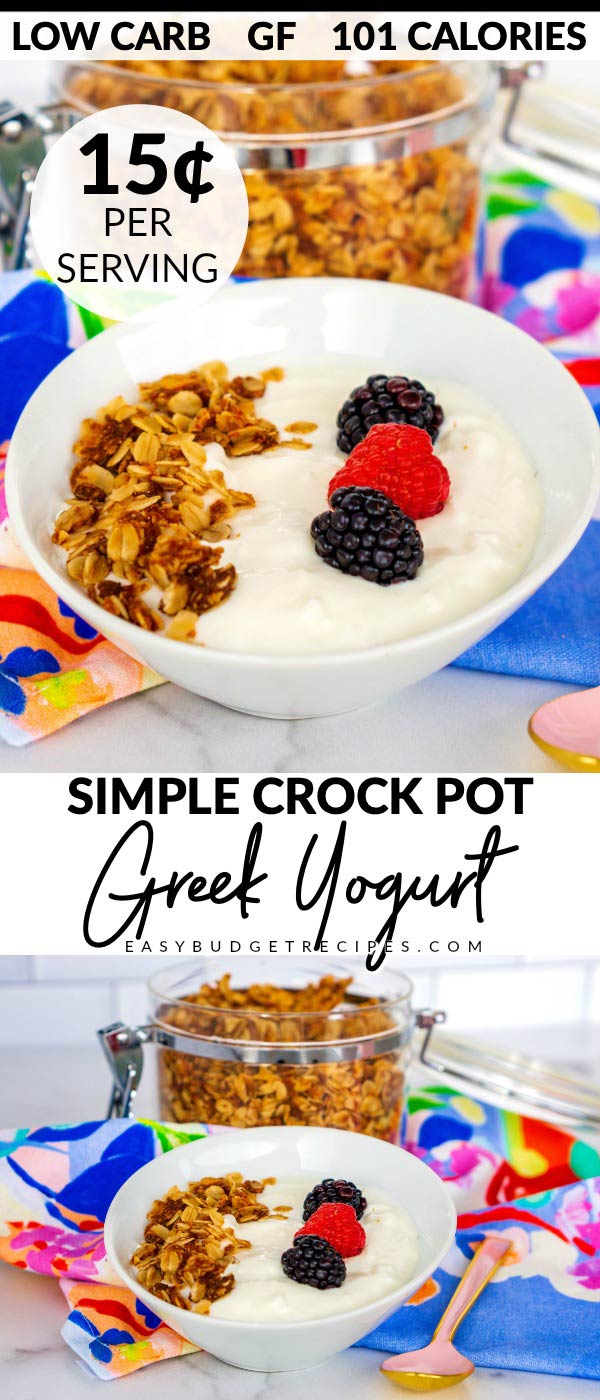
This Crock-Pot Greek Yogurt recipe is easy to make, so creamy, and very economical. The batch costs $3.63 to make 24 servings. That’s just 15¢ per half-cup serving!

Greek yogurt seems to be all the rage these days. At first, I thought it was a fad. But once I began looking into it, I realized just how many health benefits Greek yogurt offers. It is an excellent source of calcium and probiotics, just to name a couple.
I had some friends tell me about making Greek yogurt at home, and really, it seemed a little complicated, so I stayed away. However, my friends kept insisting that it was such an easy process.
So I decided to give it a go. And guess what?! I guess you know what I am going to say since this blog post is called Crock Pot Greek Yogurt. 🙂 It was awesome!
Making this recipe in a slow cooker is such an easy recipe. It also tastes great, is way healthier than store-bought, and costs way less! Do you know how much it costs per oz of Greek Yogurt in the grocery store? It’s around $0.12. You guys, our homemade yogurt costs $0.04!
It sounds too good to be true, but I promise it isn’t. It is the best Greek yogurt!
Crock Pot Greek Yogurt Recipe Questions Answered:
Can I use Greek yogurt to make homemade yogurt?
Yes! As long as the yogurt has live cultures, you can use it to make your homemade yogurt. After your first batch, you can use your homemade yogurt as the starter for the next batch. I have found that I only like to use my homemade yogurt as the starter for 2-3 batches.
Each time the batch seems to get a little tangier. On the 4th batch, I start over with a fresh activator from the store. You may like it a little more tangy tasting, though, so you may find you can go longer before needing to start fresh again.
How do you make Greek yogurt taste better?
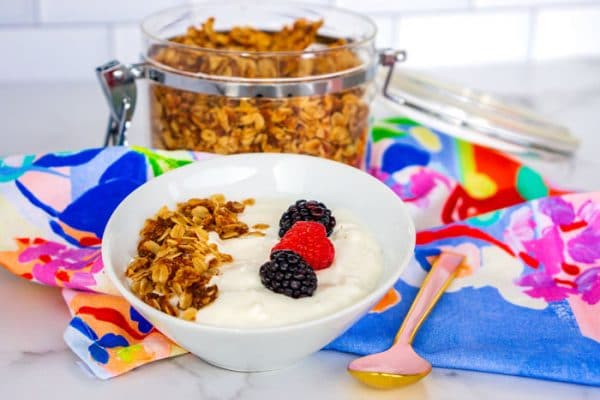
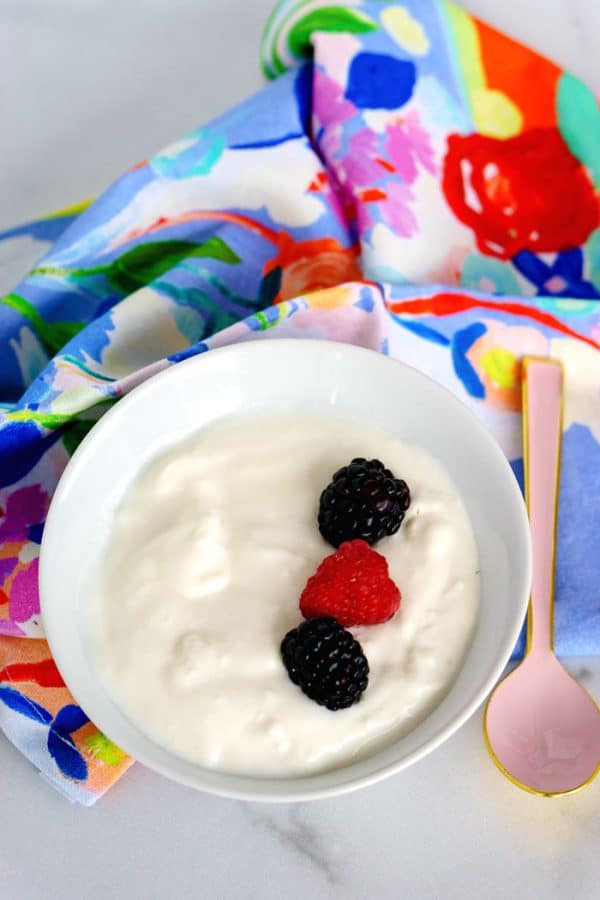
I love the taste of plain Greek Yogurt with some granola on it. However, some people find they need to sweeten it up a little bit. You can do this by adding some fresh fruit, a little bit of jam, maple syrup, or honey. Flavor extracts are a great addition as well.
What happens if you use too much yogurt starter?
The active cultures in the starter yogurt are what helps the milk set up into yogurt when it is warmed. If too much is used, the environment for the yogurt to form becomes too acidic, which blocks the process of the yogurt setting up. Double-check your measurement before you add the Greek yogurt into the warm milk.
How to get the kids involved with this recipe:
- Ages 2-3: Let them help pour the gallon of milk in the Crock-Pot.
- Ages 4-5: Let them help pour the gallon of milk in the Crock-Pot. They can also help whisk the yogurt when needed.
- Ages 6-8: Have them pour the milk in and mix in the activator. Teach them how to turn on the Crock-Pot.
- Ages 9-11: Supervise them while they prepare the entire recipe. Remember to have them read it twice before beginning the recipe.
- Ages 12+: Let them prepare the entire recipe, unsupervised, while you do the happy dance in the corner!
Discover why we love getting the kids involved in the kitchen and more tips in our How to Get Kids Involved In Cooking article.
The flavor and Recipe Variations:
- Vanilla Greek Yogurt: stir in 1 teaspoon of vanilla extract into the strained yogurt.
- Top with strawberries, bananas, blueberries, raspberries, or other fruit
More Healthy Recipes:
How long is this good for:
- Serve: As with most recipes with dairy products in them, you shouldn’t leave this yogurt out for longer than 2 hours.
- Store: Keep the yogurt in an airtight container in the refrigerator (I like to use glass) for up to 2 weeks.
- Freeze: As with most cooked dairy products, this yogurt will not freeze well.
How much will this Crock Pot Greek Yogurt cost:
RECIPE COST: $3.63
PRICE PER SERVING: $0.15
To find out more about how we price our recipes, check out Budget Recipes Explained.
NOTE: The cost of the yogurt will go down once you use a cup of your yogurt to start the batch with active cultures.
- 1-gallon whole milk – $2.47
- 1 cup plain Greek yogurt – $1.16
Cook’s Tools:
- crock-pot
- instant-read thermometer
- Cheesecloth
- large fine-mesh strainer or large colander
Crock-Pot Greek Yogurt
 Recipe Cost 3.63 Serving Cost 0.15
Equipment
- Crock-Pot
- instant-read thermometer
- Cheesecloth
- Large fine-mesh strainer or larger colander
Ingredients
- 1 gallon milk whole milk
- 1 cup plain Greek yogurt at room temperature (this will be the starter culture)
Instructions
- Pour the milk into the Crock-Pot insert, cover, and heat over HIGH heat for 2 ½ – 3 hours, or until the milk registers 180 degrees F on an instant-read thermometer.
- Turn off the slow cooker, cover, and let the milk sit until it has cooled to 110 degrees F. This will take about 2-3 hours.
- Add the room-temperature Greek yogurt to the milk and gently whisk it into the milk.
- Unplug the slow cooker and wrap it with a bath towel. Let the mixture sit for 10-12 hours (when you open the lid you’ll see that the milk be a little chunky and it will have separated some from the whey).
- Place a large fine-mesh strainer or colander over a large bowl. Line the strainer or colander with cheesecloth.
- Pour the milk mixture into the strainer or colander. Let the mixture strain for 2-4 hours. The longer you let it strain, the thicker the yogurt will be. I like to strain mine for 2 hours and I end up with 12 cups of yogurt and just over 4 cups of whey.
- Transfer the yogurt to an air-tight container and keep it in the refrigerator. The yogurt will keep for 1 ½ – 2 weeks.
- When you’re running low on yogurt, use 1 cup of this batch as your starter culture to make your next batch.






Patty Butcher says
tried this. let my milk reach 180°. did all that recipe says and mine did not set up, so I could never strain it. it is like buttermilk. any idea what I may have done wrong?
Jess Jankowski says
Hard to say exactly without knowing all the variables. Are you in a colder climate? I have been making this for years and recently moved to a colder climate. I have noticed that when my kitchen is colder during the winter months, it doesn’t set properly, so I make sure to set the crockpot in a warm place overnight.
Icer says
You instruct to use a gallon of milk, and say that you get 12 cups of yoghurt after straining it for 2-3 hours.
Depending on US or UK measurements, a cup can measure anywhere from 200~250ml.
Would you kindly consider either confirming how many cups to your gallon (or even how many cups to a quart), or just how many ml your cup measures at?
I already made my first batch of yoghurt according to my Dear Mother’s instructions, in a pot on the stove with three quarts, and probably got ⅔ of it after straining it overnight (~8hrs).
Now I am looking to make it with a crockpot, according to your instructions.
Apologies for not scoring your recipe just yet. Once I receive your clarification, I plan on scoring it then
Jess Jankowski says
Hi there! Great question, and thank you for trying the recipe. In all of our recipes, we use U.S. cup measurements, which equals about 240 ml per cup.
So, when we say that a gallon of milk yields about 12 cups of yogurt after straining, that means roughly 2.8 liters of finished yogurt. Of course, the exact yield will vary depending on how long you strain it—just like you noticed when you strained yours overnight and got a bit less. A shorter straining time (2–3 hours) will leave more liquid and give you a higher yield, while longer straining (like overnight) makes a thicker, more concentrated Greek yogurt but with less volume.
I hope that clears things up! I’d love to hear how your Crock Pot version turns out compared to the stovetop method your mom taught you.
Anne Martin says
Do you just discard the whey?
Jess Jankowski says
Yes that is what I do.
Melanie says
I save the whey in a separate container and add it to smoothies.
Jess Jankowski says
Great idea!
Amanda says
I can’t thank you enough for this Crockpot Greek Yogurt recipe. It’s simply fantastic!
Amanda says
This Greek Yogurt Made In A Crockpot is so versatile and adaptable. I can see myself making this often.
Mel says
So easy! I tried it and my family loves it.
However, I think my crock pot runs hot and it had a bit of curdling happening. Next time I’ll try it on medium to see if that helps.
Thank you for sharing!
Pierre says
Can you use Low-Fat milk instead of Whole milk?
Thanks,
Jess Jankowski says
Yes, that is what I typically use but it is not as creamy as using whole milk.
butterbean says
How long can you store the whey to use for the next batch?
Jess Jankowski says
Hello. You can store it in an airtight container in the fridge for up to two weeks. Enjoy!
Elizabeth says
Yummy! I’ve tried making crockpot yogurt before but didn’t like the results. But I wanted to try again and thought a Greek yogurt was worth trying. This recipe turned out perfectly!! So glad I found your site. My kids all love the yogurt.
Jess Jankowski says
That’s amazing! Thank you so much for letting us know. We are glad you found us too!
Judsia says
Can this be stored in the freezer?
Jess Jankowski says
We do not recommend freezing this yogurt as the texture changes after it defrosts.
Jade says
Patty I make it with half the amount of the ingredients. I make it in a smaller crockpot for the same amount of time listed in the recipe. It turns out so great!
Jess Jankowski says
Thanks for the info Jade!
Patty says
Can I cut this recipe in half? I’m the only one on the house who eats yogurt
Jess Jankowski says
Hi Patty, we haven’t tested it, but it should work just fine.
Stephan says
Instead of using your I used whey on second batch and worked just as good.
Jess Jankowski says
That’s great Stephan! Thanks for letting us know.
Erica Schwarz says
I love that I can just use a cup and keep it going and only have to get more milk. My family loves this yogurt!
Jess Jankowski says
Isn’t that so great!? It’s the recipe that keeps on giving! I make it weekly for my family. We all love it so much.
Katie says
Made this for the family and it was a hit!
Jess Jankowski says
Yay! So happy to hear that. Thanks for sharing!
SuzieW says
How do I know if a brand of yogurt has active culture?
Jess Jankowski says
Hi. If you read on the container or on the ingredients label it will say if it has an active culture in it. Thanks!